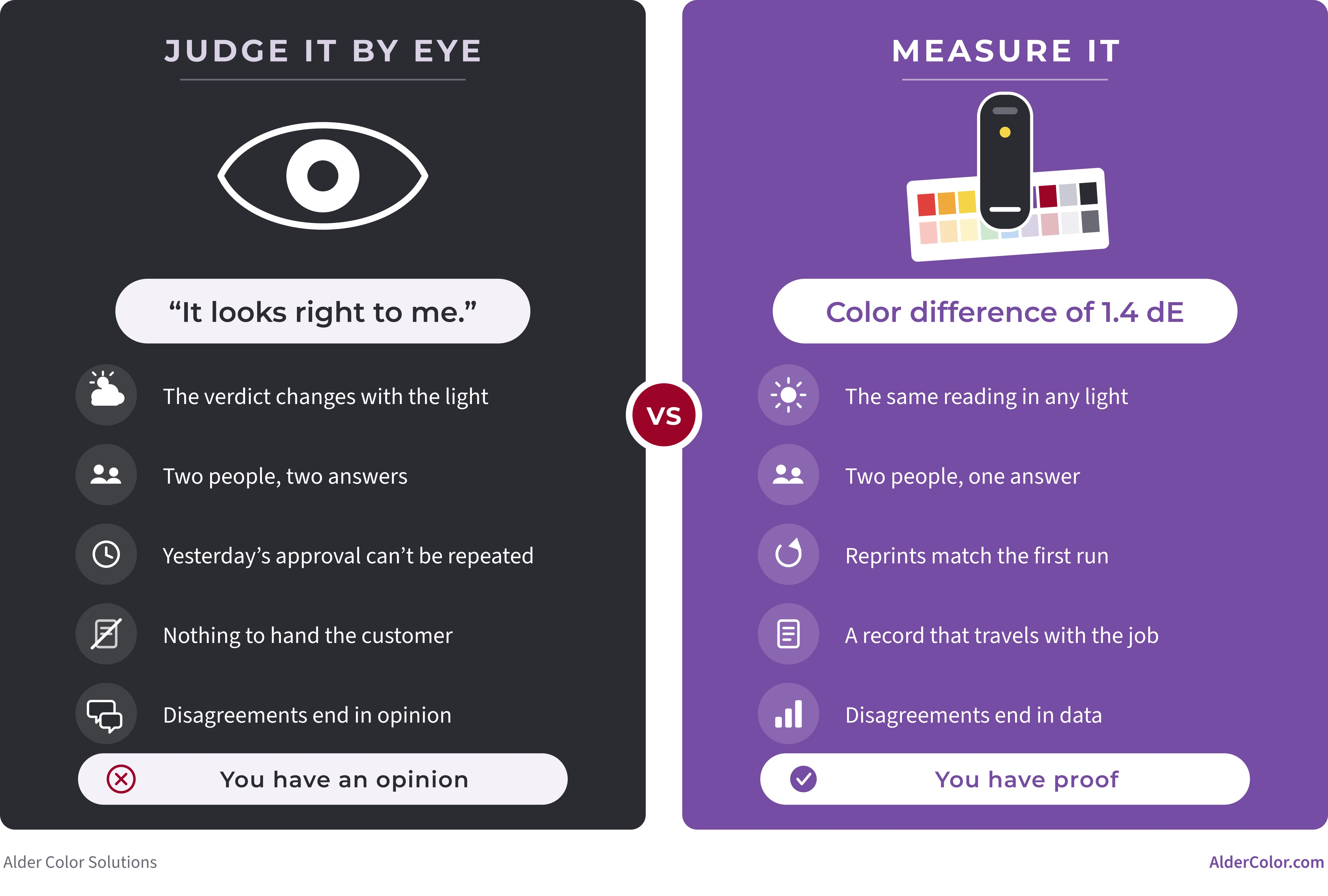
Every print shop measures color somewhere. The question is where, with what, and whether the answer ever leaves the person holding the instrument. Here are five questions worth asking about your own operation. They get harder as they go — and most shops can answer the first one comfortably and start hedging by the third. Visual matching depends on the lighting in the room, the condition of the viewing booth, what the operator looked at ten seconds earlier, and whose eyes are doing the looking. All of those vary. None of them produce a number you can put in a file. That isn't an argument against experienced operators. A good pressman catches things no instrument flags. But "it looks right to me" and "it measured within target" are different claims — and only one of them survives a customer disagreement six weeks later. Almost every color decision starts on a screen. Designers approve on a screen, CSRs review on a screen, and plenty of judgments get made against a monitor a few feet from the press console. If that screen has never been profiled, all of those decisions are being made against an unknown. Monitors drift the same way presses do. Backlights dim, white point shifts, and it happens slowly enough that nobody notices. What actually happens is that you recalibrate your own eye to whatever the screen is doing now — and it keeps looking right to you the whole way. Two people looking at the same file on two uncalibrated monitors in the same building are looking at two different colors, and both of them are confident. A profiled display gives you a screen you can trust to represent the file. It doesn't make the monitor perfect and it doesn't replace a print, but it means the conversation starts from a shared reference rather than an argument about whose screen is right. The tell: if a customer has ever approved something on screen and rejected it on paper, the screen was part of that. This is where the answers start to separate. Density tells you how much ink is on the sheet. It's the right tool for controlling the press, it's fast, and pressroom people have used it for decades for good reason. What density doesn't tell you is what color the customer is actually going to see. Two sheets can run the same density and look different. A brand owner's specification is almost never written in density, and a density reading can't be compared to the color the brand approved. L*a*b* describes the color itself. It's the language the specification is written in, and it's the only reading that answers the question the customer is really asking. Most shops need both. The gap worth noticing is when density is the only thing anyone records. A proofer that was accurate last quarter isn't necessarily accurate this morning. Printheads age, ink lots change, media changes, humidity changes. Calibration is what pulls the device back to a known state, and calibration requires measurement. There is no version of this that works by eye. If your proofing device gets calibrated when someone notices a problem, you're calibrating to the complaint rather than to a standard. Calibration and verification are different jobs, and this is the one most shops skip. Calibrating puts the device where it should be. Verification proves it stayed there and produces a record that says so. Without that second measurement you have a proof that's probably fine, and no way to demonstrate it to anyone who asks. That record is what turns color from something you promise into something you document. When a brand owner asks how you know the job matched, the answer is either a measurement file or a conversation about how carefully everyone looked at it. If you answered yes to the first couple and hesitated on the last two, you're in the same position as most of the industry — and it's a fixable one. The instruments are not exotic and the workflow is not complicated. What it takes is deciding that measurement is part of the job rather than something you do when there's a problem. Once you're measuring, the next question is what counts as close enough. That's a real question with a real answer — and it's where we're headed next. Alder Color Solutions helps printers build measurement into their workflow — from choosing the right instrument to setting up the process that captures and keeps the data. If you want to talk through where your shop sits on these five questions, get in touch. General Manager, Color Services, Alder Color Solutions · Great Western Ink Technical Representative, Northern California Lou holds a B.S. in printing science from RIT, including two co-op internships in the prepress group at the National Geographic Society. He was at Barneyscan as the desktop publishing revolution was getting started, then at Adobe as Color Evangelist when ICC profile support was first added to the applications that are now Creative Cloud. He earned G7 Expert certification in 2006, as the program was starting, and G7-calibrated dozens of presses through his own consulting practice before returning to corporate color roles at EFI, Pantone, and X-Rite. He sits on the Print Properties Committee of PRINTING United Alliance and is Great Western Ink's technical representative for Northern California.1. Do you measure, or do you look?
2. Do you measure your displays?
3. On press, do you measure density or L*a*b*?
4. Do you measure proofs and digital prints to calibrate the system?
5. Do you measure them again to verify?
Where This Goes
Schedule a Consultation
info@aldertech.comAbout the Author
Lou Prestia